
By Johanna Rehbaum
We are a story people. Humans always have been. We have always told stories to make sense of our existence as a people, to make sense of ourselves and each other. We begin telling stories to our children, but we never stop telling them, because we never stop trying to make meaning of our lives.
Our Concentus spring concert is full of stories – of resilience, of tragedy, of hope. Paper Crane tells movingly of one girl’s hope for creating peace one crane at a time, following the dropping of the atomic bomb. Everyday Wonders: The Girl from Aleppo brings into focus a current global tragedy, the refugee crisis, taking us on a journey not only from Syria to Germany, but through sadness, loss, terror, hope, relief, and finally joy and wonder.
But not all the stories are based on factual accounts of modern events. Song of Miriam, by Elaine Hagenberg, tells an ancient story via a modern text. Yet ancient as it is, it also tells a contemporary story, our stories. That’s the power of storytelling, especially when paired with art and music: no matter where or when it happened, stories we encounter have the power to help us to tell and make sense of our own stories.
Like Nujeen Mustafa in Everyday Wonders, Miriam was a refugee. Like Sadako Sasaki in Paper Crane, Miriam looked with hope and faith toward a future freedom that was uncertain. Like all of us, Miriam stood on the cusp – of the brokenness of what was, and the future of what could be – and found herself searching for her song, searching for who she was to be in this new life.
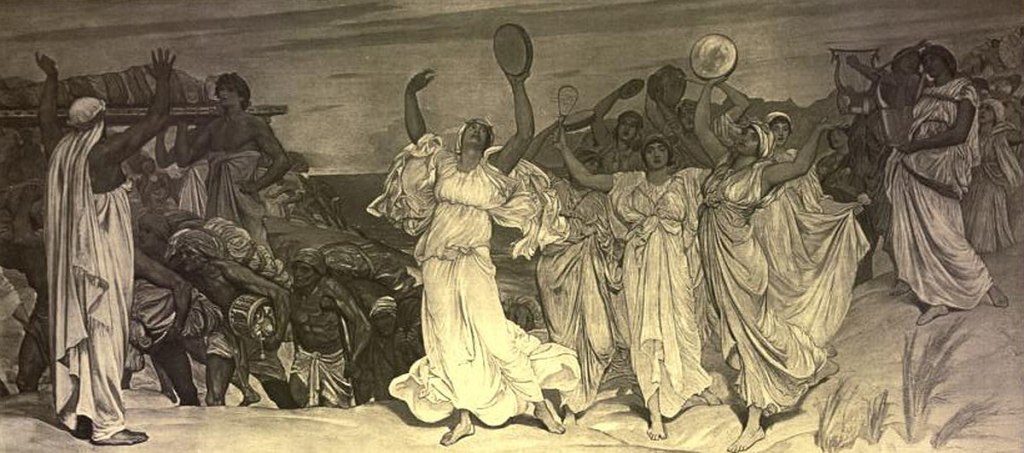
The text of Song of Miriam is written by Rabbi Ruth Sohn, and is based on the story of Miriam in the biblical book of Exodus. Miriam, the sister of Moses, was among the Israelites who crossed the Red Sea in their escape from Pharaoh and his army. That is where Rabbi Sohn imagines her in this text. Miriam and her people have just come through a traumatic ordeal: 500 years of slavery and oppression in Egypt. Finally, they have escaped, but then Pharaoh changes his mind sends his horses and chariots racing after the Israelites. In a climactic moment, the Israelites have arrived at the Red Sea. A strong wind pushes aside the waters, and they walk across on dry land. Pharoah’s army isn’t so lucky; they are drowned when the waters come crashing back in on them. Now the Israelites find themselves safely on the other side of oppression – they are finally free.
This is the central story of the Jewish faith. It has been used by marginalized and oppressed communities even beyond Judaism for thousands of years since. Who doesn’t love an epic tale of “the little guy” prevailing over the monster?
And yet… as anyone knows who has managed to break free from captivity, be it disease, abuse, a bad marriage, or whatever: new freedom can also be terrifying. Who are we in this new life? Where do we go from here? The enemy was bad, but at least it was known; what new terrors await? As Miriam frets, “In a moment of panic / My eyes go blind. / Can I take a step / Without knowing a / Destination?”
Rabbi Sohn and Elaine Hagenberg beautifully describe this moment through poetry and music. The first-person perspective gives us a glimpse into Miriam’s mind. Despite some clear references to the biblical story (for example, “I face the desert,” through which the Israelites would wander for the next 40 years in search of the Promised Land), the text could be telling the story of anyone who has stood on that cusp, with an old life behind, and an exciting but uncertain future before.
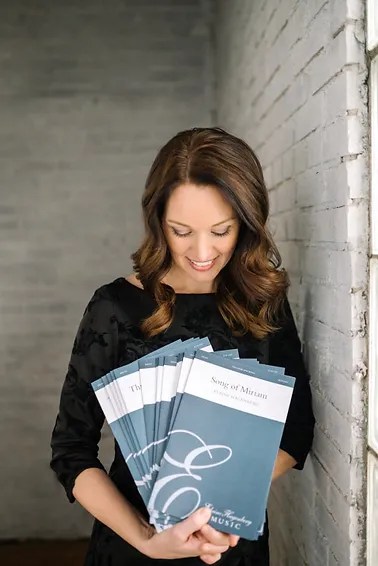
Yet knowing the story of the biblical Miriam gives this beautiful piece even more depth of meaning. In the song, Miriam several times describes wanting to sing the song in her heart – the one she feels “rising inside” her, but she doesn’t yet know the words or melody. At the end of Hagenberg’s piece, Miriam declares, in major key and soaring line, “And I hear / for the first / the song / that has been in my heart / silent / unknown / even to me.” Knowing her story, and our own, we feel her song swell even in our own hearts!
And then Exodus (15:20-21) can tell us what happens next: “Then Miriam the prophet… took a timbrel in her hand, and all the women followed her, with timbrels and dancing. Miriam sang to them.”
Would that we all be as brave as Miriam! Brave enough to sing a new song for a new world, for the hope of a future that lies before us!
We hope that you will come to experience through heart, soul, mind – and all your senses – our songs of hope and resilience for a future yet unknown, following in the footsteps of Miriam, Nujeen, Sadako, and so many other women throughout time.
Check out our other concert preview blogs:
Spring Concert Preview: Everyday Wonders
Spring Concert Preview: Paper Crane
This concert honors the work of Rochester Refugee Resettlement Services (RRRS). RRRS offers services and opportunities to ensure assimilation of refugees into our society by providing assistance as they strive to be self-sustaining neighbors while still maintaining their own cultural heritage. Concentus will be making a donation to the organization, in addition to working to raise awareness of RRRS in the community.
 Concentus Women's Chorus
2 responses to “Spring Concert Preview: Song of Miriam”
[…] Spring Concert Preview: Song of Miriam […]
LikeLike
[…] Spring Concert Preview: Song of Miriam […]
LikeLike